UX ACADEMY · MOBILE APP DESIGN
GoLocal: Helping People Create Memories in Their City
In the pace of everyday life, it's easy to overlook the places around us. GoLocal was designed to help people explore their area more intentionally — combining discovery, planning, and journaling into one cohesive app experience rooted in research.
Timeline
February – March 2021
Responsibilities
Competitive & User Research, UX/UI Design, Prototyping, Brand Identity, Iconography, Usability Testing

01 · Challenge
People live in cities for years and still feel like they never really experienced them.
Human Problem
As routines solidify, exploration becomes deprioritized. People look back on time spent in a city and wish they had done more — not because the opportunities weren't there, but because no centralized tool made it easy to find, plan, and recollect local experiences in one place.
Discovery Problem
Existing discovery apps overwhelm users with too much information and too little personalization. Finding something that matches your mood, energy level, and interests on any given day requires jumping between multiple apps with no cohesive experience.
Memory Problem
Even when people do have great local experiences, they rarely document them in any meaningful way. Memories fade, and there's no existing tool that connects the "finding" and "doing" phases with a satisfying "remembering" phase.
Why It Matters
Research on time perception shows that novel experiences make time feel richer and slower. By helping people discover and document local experiences, GoLocal directly addresses the psychological feeling of time slipping away — a deeply human pain point.

Quote from Kristin Wong
02 · Insights
The Patterns Behind Exploration
Beyond where people go, user research revealed why they explore, what prevents them from following through, and what helps experiences become meaningful and memorable.
Inspiration without overwhelm
Users wanted to feel inspired to explore, but existing apps and websites overwhelmed them with too many options and too little filtering by mood, energy, or context.
Planning friction kills intent
Many users reported having ideas for local activities that never happened because planning felt like another to-do. The gap between "wanting to" and "actually doing" was often just friction.
Memory matters more than expected
Interviewees consistently said they wished they'd documented experiences better. The desire to look back on what they'd done — and feel proud of it — was a strong, underserved motivator.
People trust recommendations
The most compelling discovery experience for users was hearing about places from other people — whether through in person connections, reviews, or social media.
Saving ≠ doing
Users frequently saved locations in Google Maps or notes apps but rarely returned to act on them. The save step felt satisfying but was rarely connected to actual follow-through.
Time perception is the deeper issue
Secondary research confirmed that novel, varied experiences make time feel slower and richer. GoLocal's opportunity wasn't just to help people do more — it was to help them feel more present in their lives.
People want to control the unknowns
Users were reluctant to risk their time on unfamiliar places without knowing what to expect. Practical details — like whether a spot had wifi, good parking, or a public restroom — were the deciding factors between "maybe someday" and actually going.
Exploration is rarely a solo act
Users often weren't just planning for themselves — they were coordinating for a group or looking for ways to share what they found. The desire for collaborative elements, from shared planning to broadcasting experiences, surfaced again and again.
03 · Journey
From research to high-fidelity.
Click any card to explore the artifacts and thinking behind each phase.
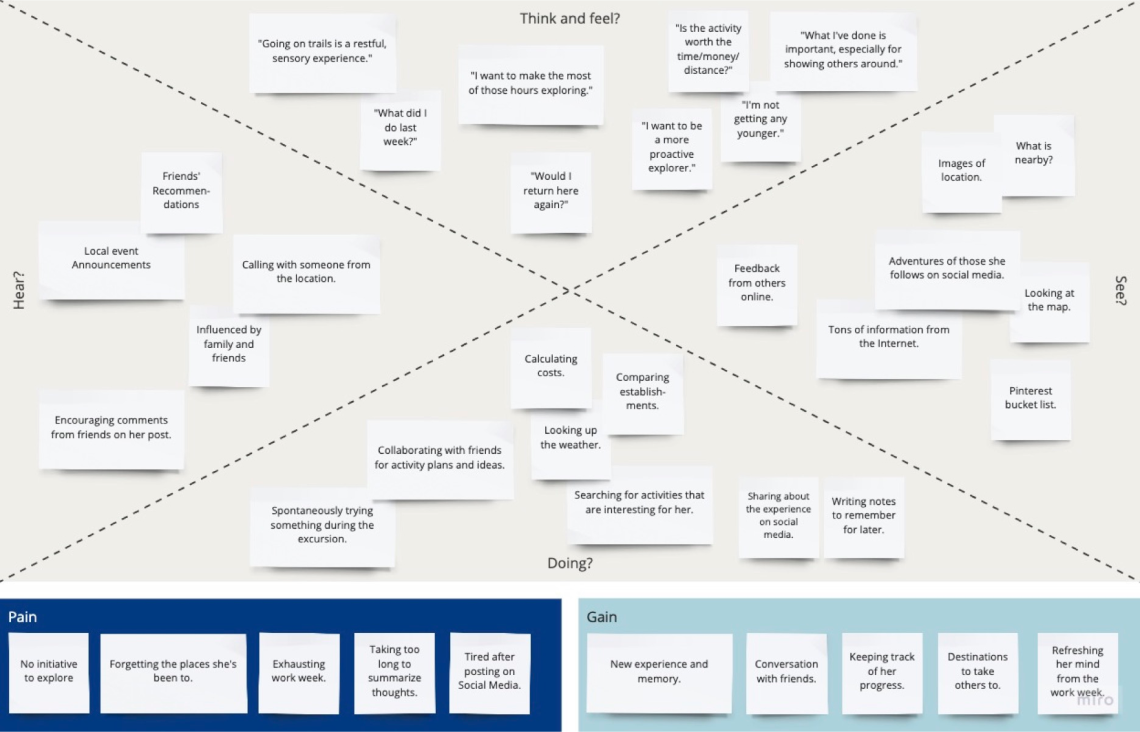
Research
User Interviews & Empathy Mapping
In-depth interviews revealed the tension between inspiration and overwhelm across the four stages of local exploration.

Research
Competitive Analysis
Testing the top-ranked journal and trip planning apps to identify gaps that GoLocal could fill.

Strategy
POV Statements & Mind Map
Translating research into actionable design scenarios and exploring solution directions.

Strategy
Feature Roadmap
Iterating on a prioritized feature set grounded in research and validated against real user needs.

Strategy
User Flows
Mapping the end-to-end app journey across all five core stages.

Design
Brand Identity
Creating a visual identity that captures curiosity, connection, and local discovery.

Design
Wireframes
Progressive wireframing from paper to digital before investing in visual design.

Validation
Usability Testing
Structured usability sessions with real users to validate flows and refine the experience before final delivery.
04 · Solution
One app for the full arc of local exploration.
GoLocal unites discovery, planning, and memory into a single cohesive experience — built around the moments that matter most to explorers.
Discovery
Personalized local experiences matched to your mood.
GoLocal's discovery layer goes beyond generic recommendations by filtering by mood, energy, category, and proximity. Instead of a wall of options, users see a curated set of experiences that match how they feel right now — reducing decision fatigue and inspiring action.
Mood-based discovery reduces the gap between "wanting to explore" and "actually going out the door."
Planning
Save, organize, and plan — without leaving the app.
Users can save discoveries to personal lists, build itineraries, and plan visits directly within the app. By closing the loop between saving and doing, GoLocal removes the friction that causes saved ideas to be forgotten.
Integrated planning bridges the gap between inspiration and action — the most common drop-off point in local exploration.
Memory
A personal journal for experiences worth remembering.
After an experience, users can create rich journal entries with photos, notes, and ratings — building a living record of their local adventures. Over time, GoLocal becomes a personal archive of memories, not just a discovery tool.
Memory capture transforms GoLocal from a utility into something users feel emotionally connected to over time.
05 · Impact
Designed to be felt, not just used.
Because GoLocal is an app concept, product impact is represented through completed design outcomes alongside the validation metrics and growth opportunities that would guide success after release.
Design Outcomes
End-to-end user flow validated from discovery through documentation
Brand identity created from scratch: logo, color, and typography
Flexible, personalized filtering designed to reduce discovery friction
Journal feature designed to create emotional long-term attachment to the app
How I Would Measure Real-World Impact
Session frequency: are users returning more than once per week to discover or plan?
Journal completion rate: % of "experiences saved" that result in a completed journal entry
Discovery-to-plan conversion: how often does a saved place become a planned visit?
NPS and sentiment surveys: does GoLocal make users feel more connected to where they live?
Opportunities the Design Unlocks
Social layer: sharing discoveries or journal entries with social media or friends adds a recommendation trust signal
Location-based nudges: contextual reminders when users are near a saved place
Memory recap: monthly "look back" feature surfacing past journal entries to reinforce the value of exploration
Community lists: curated recommendations from locals in your city create authentic discovery
06 · Reflection
What designing GoLocal taught me.
Research Changes the Solution
I started this project with assumptions about what a local discovery app should be. The interviews and empathy map changed the scope significantly — particularly revealing how important the "remembering" phase was, which became a central feature rather than an afterthought.
Connection Over Utility
The most resonant products don't just solve problems — they make users feel something. GoLocal's journal feature was designed not just for information capture, but for emotional connection over time. That distinction shaped every micro-interaction.
The Importance of User Flow First
Mapping the five-stage journey (Find → Save → Plan → Experience → Document) before touching visual design was the most valuable structural decision I made. It clarified how features connected and prevented the kind of siloed thinking that produces disjointed app experiences.
Designing for the Long Term
The best features in GoLocal are ones that compound in value over time — a journal that grows richer with every entry, a saved places list that reflects the arc of your life in a city. Designing with longevity in mind changes what you prioritize.
Next Project